Thickening of the Achilles Tendon & Achilles Tendinopathy

Chronic Achilles tendinopathy: Causes of Achilles tendon thickening
Pathology: Collagen Changes and Risk of Achilles Tendon Rupture
The tendon is usually thickened in the chronic stage. The chronic inflammation causes lasting pain (often a deep dull pain) and leads to a weakening of the Achilles tendon. The cause of this lies in the fact that the Type 1 collagen that makes up 95% of collagen in a healthy Achilles tendon has been replaced by the significantly weaker Type 3 collagen. This also happens in the context of Achilles tendon injuries, as the fibroblasts that migrate from the blood vessels as a reaction to the injury primarily produce Type 3 collagen. The Achilles tendon can sometimes later tear as a result.

Causes of Pain Due to Vascular and Nerve Invasion
New research shows that an additional problem is that growing blood vessels, which should heal the Achilles tendon, also pick up small nerve endings, which can react to pulling with severe pain.
Treating Chronic Achilles Tendonitis
Die besten Ergebnisse erzielt man in diesem Stadium mit einer Kombination aus täglichen exzentrischen Muskelübungen, podologischen Einlagen (die v.a. im täglichen Leben getragen werden sollten) und Physiotherapie – in Kombination mit dem Repuls Tiefenstrahler (s.o.).
Eccentric muscle exercises: A Swedish study showed that patients with chronic Achilles tendon symptoms were able to achieve a full recovery within 12 weeks if they carried out eccentric exercises consistently. It was astounding that all the athletes studied had already had treatment-resistant symptoms for two years.
The exercise involves standing on a step with the ball of the foot and lifting the heel slowly upwards (one can also do it with both foot for stability) and then slowly lowering the heel and pressing it down as far as possible, significantly stretching the Achilles tendon. The authors of the study also recommended wearing a heavy rucksack to add more weight to the stretch. Dr. Gäbler, however, feels that this is somewhat excessive, as the stretching is the important part, not the lifting the heel.
Such muscle exercises cause small vessels to necrotise on the one hand (and therefore also the painful nerve endings), and on the other, the exercises increase the production of Type 1 collagen, which heals and strengthens the tendon.
It often takes months, however, until symptoms actually improve, which is obviously very detrimental to any keen runner, as only very limited running is permitted during this time.
See also - Video
Surgery for Achilles Tendonitis
Surgery for Achilles Tendonitis: Surgical Treatment of Chronic Achilles Tendon Pain
In the event of chronic symptoms, an operation may be indicated if conservative treatments fail.
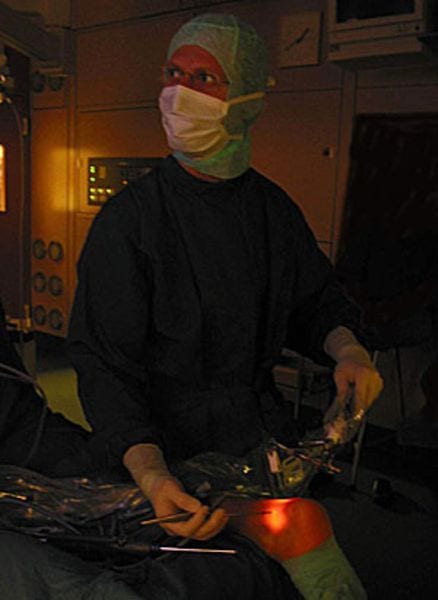
The Endoscopic Achilles tendon decompression is a minimally-invasive operation method that often leads to excellent outcomes in cases of chronic achillodynia and Haglund’s deformity . The operation removes layers that have been altered by inflammation and mills off any ossification. Immobilization in a cast is required is required for 2–4 weeks after the procedure.
Bei sehr ausgeprägten Fällen ist ein größerer Hautschnitt erforderlich. Die Achillessehne wird längsgespalten und die abgestorbenen, zentral gelegenen Sehnenanteile werden entfernt. Dann kann die Sehne wieder vernäht werden.
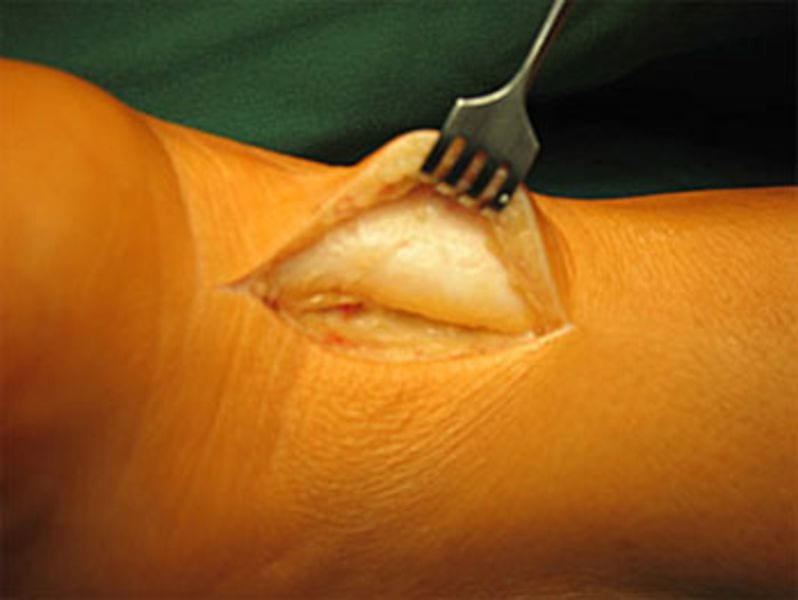
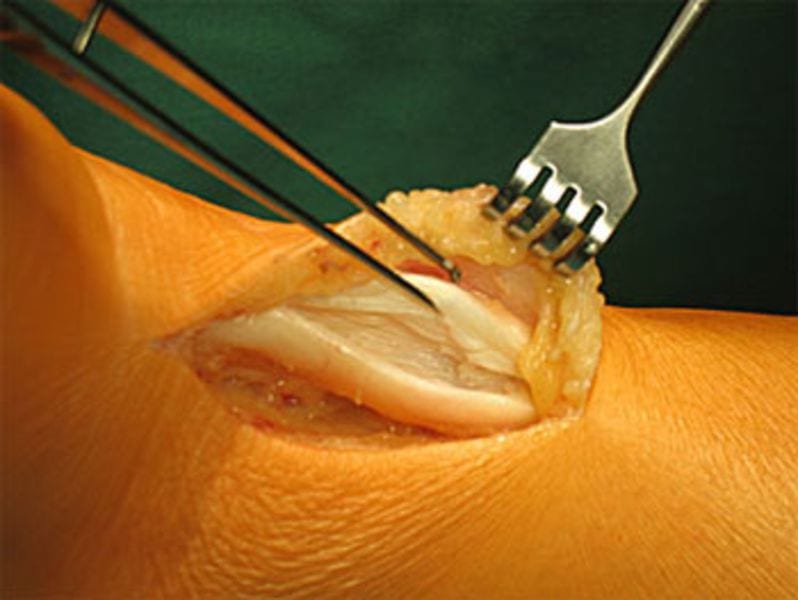
It is particularly easy to remove Haglund’s deformities using this method. The disadvantage is, of course, the somewhat larger skin incision.
Advice on Achilles tendinopathy
Our experts are happy to help you
Just give us a call!